
Cable-powered vibration sensor

Cable power. Wireless measurements.

Request a quotation

Capture vibration while the machine is active

Measure vibration and temperature on CNC machines, conveyors and other equipment with stop-start cycles. Power the sensor from the machine’s DC supply and send recordings wirelessly to the M4.
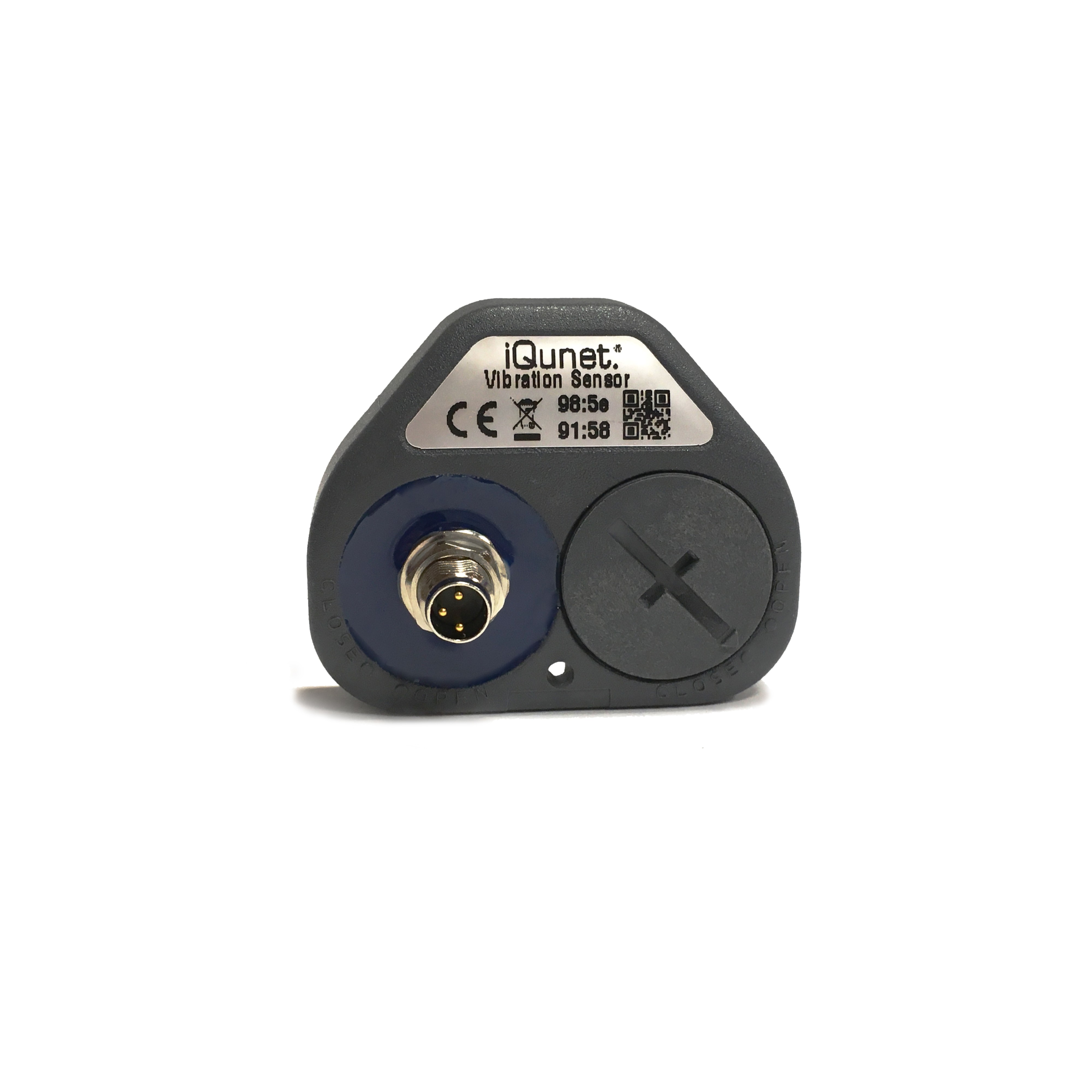
6–60 V DC through the M8 connector
iQunet cable-powered vibration sensor with M8 power connector and backup battery cover
X · Y · Z Temperature
Vibration channels
X · Y · Z recorded together
Sampling rate
12–3,200 samples/s · selectable
Recording length
32–8,192 samples per axis · selectable

Capture the active part of the cycle

When a machine starts and stops, the timing of a recording matters. Compare the two capture modes on the same operating cycle.

Compare capture modes
Z-axis vibration activity
IdleMachine runningIdle
Repeated recordings
Interval startInterval end

Capture machine activity

Peak keeps the recording with the strongest Z-axis activity. All three axes are retained together.

Operating-cycle illustration · On DC power, the radio stays awake in both modes.

Inspect the waveform and its spectrum

Open recordings in Vibration Expert to inspect impacts in the time waveform and frequency components in the FFT spectrum. Compare recordings in waterfall plots and export the samples for your own analysis.

Vibration ExpertGear mesh & sideband analysis
Software example · X axis · 1,600 samples/s · 4,096 samples. Click to enlarge.

Vibration Expert

Use the M4’s OpenAI MCP connection to explore measurement history with ChatGPT or Codex.

AI analysis & reporting

Connect to your M4

Supply DC power at the machine and transfer measurements wirelessly. The M4 stores recordings locally for browser analysis and access through OPC UA, MQTT or GraphQL.

6–60 V DC supply
M8 power cable
iQunet cable-powered vibration sensor with M8 power connector and backup battery cover
Cable-powered sensor
Sub-GHz radio

Edge Gateway M4

with iQunet radio interface

Local storage & analysisExplore the M4

Compact IP68 enclosure · 40 g

57 × 47 × 14 mm, excluding M8.
M3 screw, magnetic or epoxy mounting.

Technical details

Measurement specs

Installation

Product data

Datasheet PDF
Are the vibration channels synchronised?

The current sensor records X, Y and Z together. Peak mode retains the three axes from the same recording. Separate wireless sensors use independent clocks, so their recordings are not phase-synchronised.

What happens if the DC supply is interrupted?

A CR2032 backup cell supports short-term operation. The sensor sleeps between wake-ups instead of listening continuously, so brief machine activity between wake-ups can be missed.

Request a quotation

Cable-powered vibration sensor

Tell us about your machine. We’ll help specify the sensor and connections for your installation.
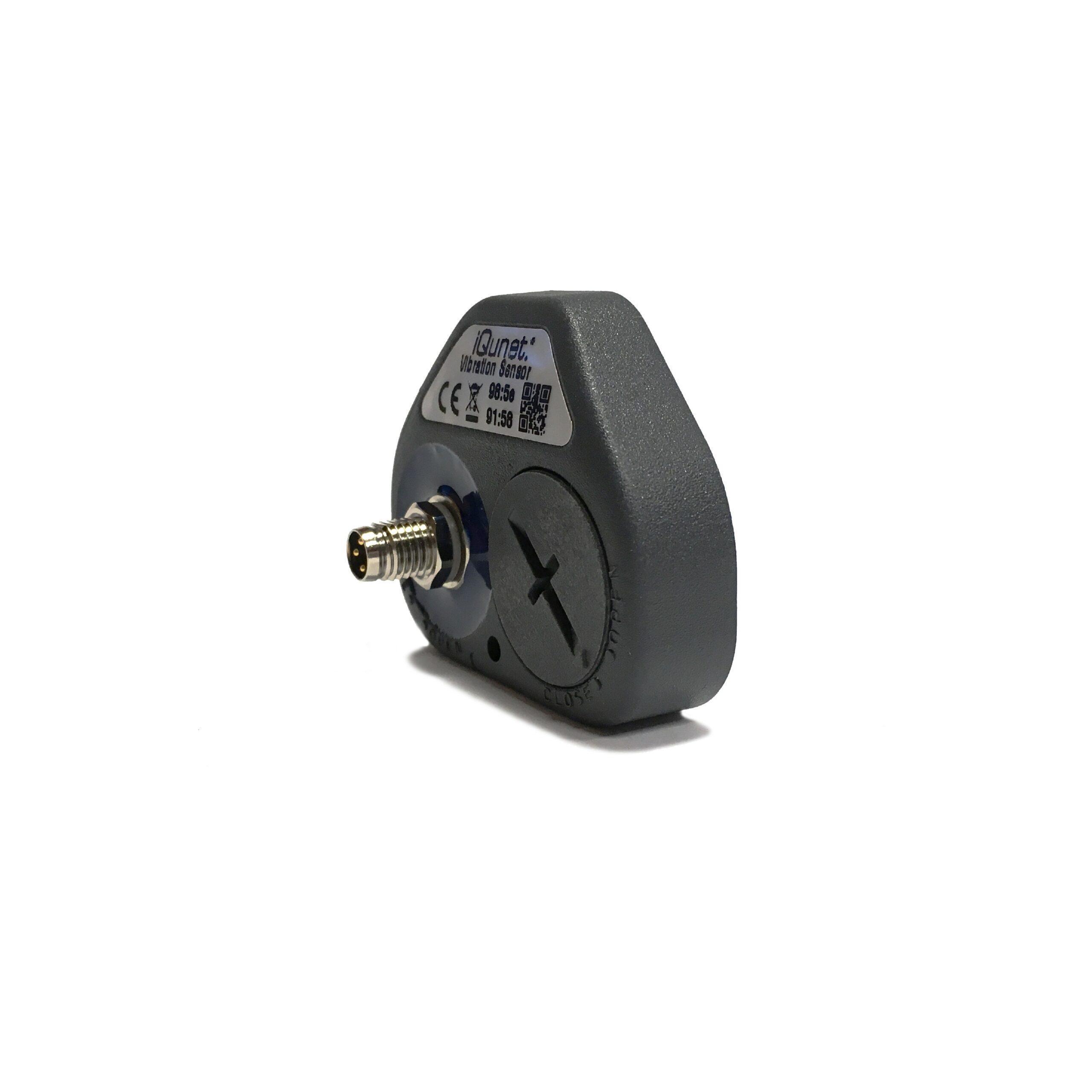
Three-quarter view of the iQunet cable-powered vibration sensor and M8 power connector

€589.42 per sensorExcl. VAT & shipping. Configuration confirmed with your quotation.

Cable-powered vibration sensor

Technical details

Vibration & recording specifications

Configure recordings remotely from the dashboard. The current sensor captures X, Y and Z together and also measures internal temperature.

Vibration range
Selectable ±2, ±4, ±8 or ±16 g
Sampling rate
12–3,200 samples/s
Recording length
32–8,192 samples per axis
Channels
X, Y and Z vibration; internal temperature
FFT frequency range
Up to 1,600 Hz at 3,200 samples/s; the measured response also depends on the sensor and mounting
Analysis on the M4
Time waveforms, FFT spectra, waterfall plots and sample export
Processing options
Acceleration in g or velocity in mm/s; averaging and high-pass filtering

At 3,200 samples/s, 8,192 samples cover 2.56 seconds with 0.391 Hz FFT bin spacing. At 400 samples/s, the same sample count covers 20.48 seconds with 0.049 Hz bin spacing. Sampling rate is distinct from usable measurement bandwidth.

Peak & Instant capture

Peak mode
With external power, repeated recordings are evaluated during each interval. The retained recording is downloaded at the interval end if it qualifies for the configured threshold.
Selection channel
Peak mode evaluates Z-axis vibration activity and retains the corresponding X, Y and Z recording.
Instant mode
A recording is made at the scheduled time. Optional retries can add attempts when the threshold is not met.
Between recordings
On DC power, the radio stays awake. After an Instant recording is downloaded, measurement waits in standby for the next request. Peak mode repeats recordings through the interval.
Manual recording
REC requests an instant recording.
Download threshold
Select None to download recordings without threshold filtering. A threshold can exclude recordings made while the machine is idle.

Peak mode retains a recording from the interval, rather than a continuous history of every capture. Set the interval and recording duration around the machine’s operating cycle.

Capture modes & download thresholds

Power & mounting

Supply
24 V DC nominal; 6–60 V DC input
Current
10 mA maximum
Connector
3-pole M8 for DC power; signal contact unused
Backup
One CR2032 coin cell for short-term fallback; the sensor sleeps between wake-ups while external power is absent
Mounting
M3 screw, magnetic or selected epoxy mounting
Power cable
Matching M8 cable, with 5 m and 10 m options
Antenna clearance
Keep the 80 mm area shown in the mounting drawing clear of metal

Mount rigidly to the measurement surface and secure the cable so it does not load the sensor. Follow the installation document for connector wiring, antenna clearance and sealing.

PDFCable-powered sensor installationPower cables & accessories

Wireless data connection

Measurement data travels over the iQunet sub-GHz radio network. The M4 receives recordings through a compatible iQunet radio interface and stores them locally. Select the matching radio band for the sensor and network hardware.

8A radio
868 MHz band
9A radio
915 MHz band
Network hardware
M4 with compatible iQunet radio interface; existing installations may use the original USB Base Station
Radio coverage
Typically up to 50 m in plant conditions; layout and placement affect coverage
Coverage extension
Compatible iQunet Repeater
M4 data access
Browser analysis, OPC UA, MQTT, GraphQL and OpenAI MCP
Wireless network components

Sensor specifications

IVIB161410-24V-PWR · 8A / 9A · D1636 specification

Measurements
Three-axis vibration and temperature
Dimensions
57 × 47 × 14 mm, excluding the M8 connector
Weight
40 g
Enclosure
IP68
Operating temperature
−20 to +85 °C
Power
24 V DC nominal; 6–60 V DC input
Backup cell
One replaceable CR2032

Earlier catalogue versions list 35 g, IP65 and −20 to +70 °C. Use the documentation for the installed model; the original product release specifies server software 1.3.1 or later.

Datasheet & installation references

PDFCable-powered vibration sensor specificationPDFVibration sensor feature comparisonPDFCable-powered sensor installationPDFEarlier cable-powered sensor connection scheme
iQunet · Engineering enquiries

Ask us a question

Ask about our products or pricing, request a demonstration, or get technical help.

About your question

About: Cable-powered vibration sensor

Request type: General question
Prefer email or a call?info@iqunet.com+32 52 86 00 25

We use your details to answer this request. Privacy information (new tab)